
People often search for a “teacup Yorkie,” “micro Yorkie,” “mini Yorkie,” or “tiny toy Yorkie” when they hope to find a very small Yorkshire Terrier. These phrases are common in puppy listings, but they are informal size labels—not separate Yorkshire Terrier breeds or recognized size classifications.
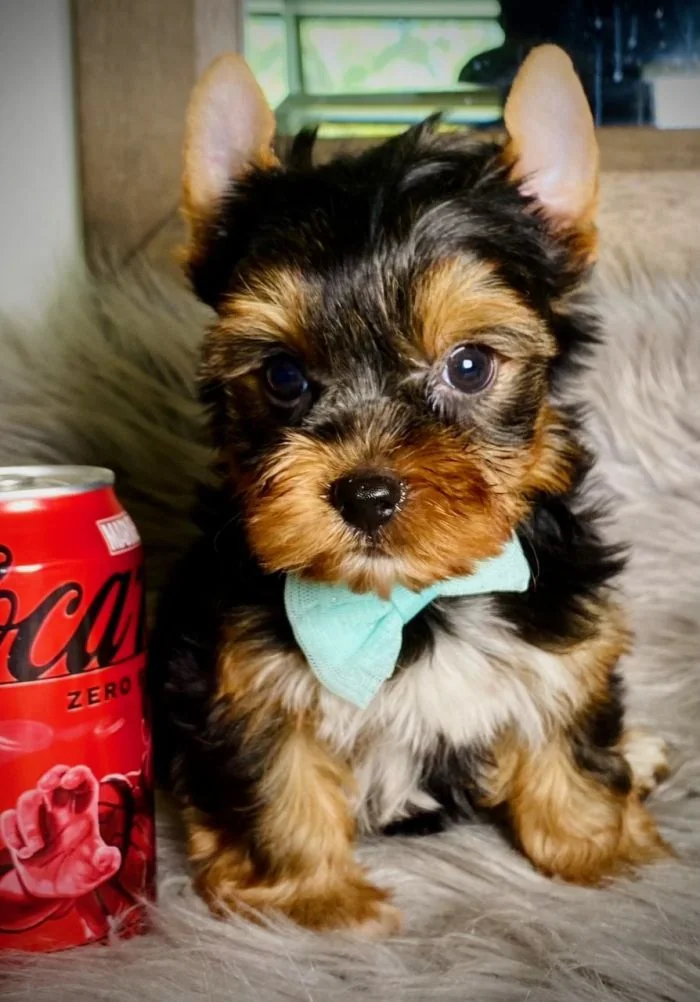
What does “teacup Yorkie” mean?
“Teacup” usually describes a Yorkshire Terrier expected to be especially small. The word does not come with one official weight range, and different sellers may use it differently. The same is true for “micro,” “mini,” and “tiny toy.”
The American Kennel Club recognizes one Yorkshire Terrier breed. Its official breed standard says a Yorkshire Terrier must not exceed seven pounds; it does not create separate teacup, micro, mini, or tiny toy varieties.
Can a breeder guarantee a Yorkie’s adult weight?
No one can promise an exact adult weight for a young puppy. Current growth, the size of the parents, genetics, development, and health can all affect a dog’s final size. A breeder may share an estimate, but it should always be labeled as an estimate rather than a guarantee.
Instead of relying on a size label, ask for the puppy’s age, current weight, and the date that weight was recorded. You can also ask about both parents and how earlier puppies from the same lines developed. That information gives you useful context without turning a prediction into a promise.
Questions to ask about a very small Yorkie puppy
What is the puppy’s current age and weight?
Ask for a recent measurement with a date. A number without the puppy’s age or the date it was recorded does not tell the full story.
Who are the puppy’s parents?
Ask to see the sire and dam and to learn their adult sizes. Parent size can help inform an estimate, but it still cannot determine a puppy’s exact adult weight.
Which records are available?
Ask which veterinary, registration, parentage, or health-screening records are available for the puppy and parents. Each record answers a different question, so ask what it documents and when it was completed.
What care will this puppy need?
Very small puppies can require careful daily routines and a home prepared for their size. Ask what the puppy is currently eating, which care instructions come home, and when the breeder recommends the first veterinary appointment. Your veterinarian should guide feeding, preventive care, and any health concerns for your individual puppy.
Choose the puppy, not the label
Size may be part of what first catches your attention, but it should not be the only reason you choose a puppy. Look at temperament, current health information, parent records, care needs, and fit for your household. A responsible conversation focuses on the whole dog rather than promising the smallest possible number.
Teacup Yorkie size questions
Is a teacup Yorkie a separate breed?
No. It is an informal term for a very small Yorkshire Terrier.
Are micro, mini, and tiny toy Yorkies different from teacup Yorkies?
These are overlapping marketplace terms, not official Yorkshire Terrier varieties. Their meaning can change from one seller to another.
What should an adult-weight estimate include?
Ask what information the estimate is based on and make sure it is presented as a prediction, not a guarantee. Current age and weight, parent size, and the puppy’s development provide context.
The bottom line
“Teacup Yorkie” is a familiar search term, but the dog is still a Yorkshire Terrier. Ask for specific, dated information and keep health, care needs, and household fit at the center of your decision.
Source: American Kennel Club Official Standard of the Yorkshire Terrier.